


— THE VISION
Decentralized Intelligence — The collective archive blockchain network.
An AI built by humanity, trained by humanity, owned by humanity — and accountable to no one but humanity.
— WHY THIS VISION EXISTS
Every AI system today is shaped by the organization that built it. Its training data, its values, its blind spots, its agenda — all controlled by a single point of power. Decentralized Intelligence is a vision for a different kind of intelligence: one that emerges from the distributed knowledge, beliefs, and lived experiences of all of humanity — with no single hand on the dial.
STATUS
Active Research
TIMELINE
5-10 Years
PRIMARY DOMAIN
AI · Distributed Systems
WONDER INDEX
★★★★★
— WHAT IS IT
What I imagine building.
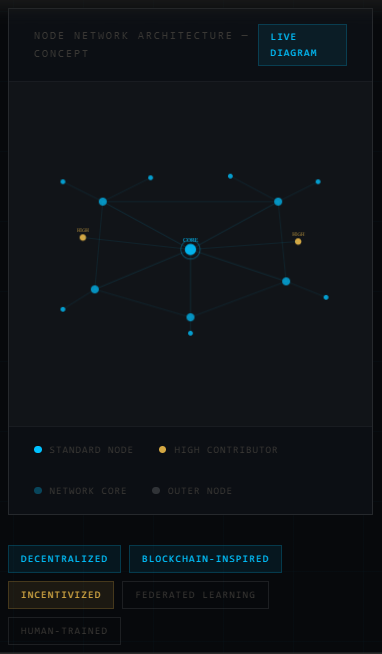
The Collective Archive Blockchain Network is a decentralized AI system — trained not by a corporation, but by every person who uses it. Each user is both a consumer and a contributor, a node in a living mesh of human knowledge, experience, and perspective.
Like a crypto blockchain, the network distributes both the processing and the data across millions of individual devices. No single server. No single owner. No single agenda. The intelligence that emerges is not the product of one culture, one political orientation, or one organization's incentives — it is the aggregate signal of humanity at large.
But the Collective Archive Blockchain Network is not just an archive. It actively challenges its users — surfacing perspectives from people whose lived experiences contradict your own, asking the questions that push back against your assumptions, celebrating the outlier thought rather than flattening it. In a world where AI threatens to make all thinking converge, this system is specifically designed to keep thinking divergent, plural, and alive.
Users earn incentives for contributing — not just usage, but quality contributions: personal experiences, knowledge artifacts, challenges to dominant narratives. The rarer and more distinct your contribution, the greater your stake in the network.
— SYSTEM ARCHITECTURE
How the network is structured.
"No one person knows the entire truth of life. But as a collective, we begin to see the whole picture — through the sum of our beliefs, experiences, and contradictions."
I — Device-Level Nodes
Every user's device becomes a node in the network — contributing processing power, local training data, and knowledge contributions. No central server holds the intelligence. The network is the sum of every participating device, globally distributed.
II — Federated Learning Model
Training happens locally on each device. Only anonymized model updates — never raw personal data — are shared with the network. The AI learns from your experience without ever possessing it. Privacy is architectural, not promised.
III — Blockchain Governance Layer
A transparent, immutable governance layer records every contribution, decision, and model update. No single entity can alter the record. Structural parameters — encoded at the protocol level — prevent any individual, organization, or government from seizing dominant control.
IV — Contribution Incentive System
Users earn stake in the network by contributing: personal knowledge, lived experience, perspective challenges, and rare-viewpoint data carry higher reward than common information. The rarer and more distinct your contribution, the greater your stake. This creates natural incentive to maintain diversity of thought.
— THE INCENTIVE MODEL
Why people will use it and build it.
The hardest problem in decentralized systems is not technical — it is behavioral. Getting people to participate requires that participation delivers genuine value. The Collective Archive Blockchain Network's incentive model is designed so that every action that benefits the individual also benefits the whole.
YOU JOIN
Device becomes a node. Your processing contributes to the network.
YOU CONTRIBUTE
Knowledge, experience, challenges to dominant ideas earn stake a crypto-like reward.
NETWORK GROWS
Richer, more diverse intelligence emerges. Everyone benefits.
— DESIGN APPRAOCH
How I would build toward it.
This vision sits at the intersection of distributed systems engineering, behavioral economics, AI research, and product design. The design challenge is not just technical — it's human. Here is how I would approach it from a design and systems perspective.
01
Map the Existing Landscape — Federated Learning & Blockchain AI
Research what already exists: federated learning (Google's work with Gboard, Apple's on-device AI), existing blockchain AI projects (Fetch.ai, Ocean Protocol, SingularityNET), and the failure modes of prior decentralized AI attempts. The design must stand on the shoulders of this work while solving what they missed.
Deliverable: Competitive & technical landscape synthesis
Design the Governance Model Before the Technology
The most critical design decision is not architectural — it's constitutional. What are the inviolable rules of the network? How are disputes resolved? What triggers a supermajority vote? I would spend more time on the governance document than on any technical spec. A network with weak governance will be captured, no matter how elegant the cryptography.
Deliverable: Network Constitution draft — governance rules & anti-dominance parameters
02
Design the Contribution UX — Making Knowledge Donation Intuitive
The hardest UX problem: how do ordinary people contribute meaningful training data without knowing they're doing it? This requires designing ambient contribution flows — moments where sharing an experience, rating a response, or flagging a perspective gap is as natural as a like button. The friction of contribution must approach zero.
Deliverable: Contribution UX model + interaction design spec
03
Prototype the Perspective Diversity Engine
The anti-homogenization system is this vision's most novel design challenge. How does the network detect that perspectives are converging? How does it surface divergent viewpoints without feeling like a lecture? How does it reward intellectual risk-taking without rewarding misinformation? This requires a dedicated design research phase.
Deliverable: Diversity engine prototype + user testing findings
04
05
Build Coalition — This Cannot Be Built Alone
The Collective Mind Network requires a coalition: distributed systems engineers, AI researchers, behavioral economists, ethicists, legal scholars, and community builders. The design vision must be compelling enough to recruit these partners before a line of code is written. A white paper and design vision document are the first real deliverables.
Deliverable: Public white paper + coalition building strategy
— HONEST CHALLENGES
What makes this genuinely hard — and how I'd explore solutions..
This is one of the most technically and socially complex visions in this collection. The challenges are real, significant, and unsolved. That's exactly why it's worth exploring.
-
Preventing bad actors from flooding the network with fake nodes to seize influence.
A decentralized network is only as trustworthy as its ability to prevent coordinated manipulation. A well-resourced actor — a government, a corporation, a coordinated ideological group — could create thousands of fake nodes to flood the training signal with a particular perspective, effectively achieving the centralized control the network was designed to prevent.
How I'd explore this
Study existing Sybil-resistance mechanisms: proof-of-personhood systems (Worldcoin's approach, though with significant privacy concerns), stake-weighted voting with diminishing returns above threshold participation, and contribution quality scoring that weights rarity and cross-cultural validation over raw volume. The key insight: it's harder to fake genuine human diversity than to fake volume. Design the contribution model around qualitative uniqueness, not quantity.
-
Collective belief can be collectively wrong.
Decentralizing AI training means decentralizing the responsibility for truth. But collective human belief is not always correct — flat earth, medical misinformation, historical propaganda. If the network simply reflects what humanity believes, it risks encoding the full spectrum of human delusion alongside human wisdom. A system trained on collective belief without epistemic guardrails is not intelligence — it's a mirror of our worst shared failures.
How I'd explore this
This is the deepest design challenge. Explore a dual-layer architecture: a "belief layer" that accurately represents what humans think (including contested and minority views), and an "evidence layer" that tracks empirical consensus from scientific, historical, and verifiable sources — clearly labeled and never conflated. The network doesn't pretend to arbitrate truth, but it is honest about the distinction between belief and evidence. Users see both layers. Neither is hidden.
-
A network that excludes the offline world is not truly collective.
A device-based node network skews immediately toward the wealthy, connected, and technologically literate. The 2.7 billion people without reliable internet access — disproportionately from the Global South, elderly populations, and economically marginalized communities — are structurally excluded from shaping the intelligence that will increasingly shape their world. A "collective human" AI that reflects only the connected half of humanity is not collective at all.
How I'd explore this
Design low-bandwidth and offline contribution modes from day one — SMS-based contribution, voice memo knowledge capture, community hub nodes that serve rural populations. Build partnerships with NGOs and humanitarian organizations to establish contribution pathways for underrepresented populations. Weight contributions from underrepresented geographic, linguistic, and demographic nodes higher in the training signal to actively correct for structural access inequality.
-
How do you maintain signal quality as the network scales to billions.
As the network grows, the ratio of low-quality to high-quality contributions will likely worsen. The incentive to game the contribution reward system will grow. At planetary scale, even a small percentage of low-quality input represents millions of contaminated training samples. The system that works beautifully at 10,000 nodes may collapse in signal quality at 10 million.
How I'd explore this
Design a multi-tier contribution validation system: automated quality scoring, peer validation (contributions are cross-validated by geographically and demographically diverse nodes before being weighted into training), and a reputation system with long time horizons — making it economically irrational to game contributions in the short term. Study how Wikipedia maintains quality at scale despite open contribution, and what its failure modes reveal about governance design at the edges.
-
Governments may attempt to mandate exclusion or backdoors.
A truly decentralized, ungoverned AI network will trigger regulatory intervention in authoritarian states and significant legal scrutiny in democratic ones. Governments may ban node participation, require data disclosure, or mandate the ability to censor network outputs. The very property that makes this network valuable — its resistance to centralized control — makes it a target for centralized power.
How I'd explore this
Study how Tor, Bitcoin, and decentralized publishing networks have navigated regulatory pressure. Design the protocol to be jurisdiction-agnostic at the architecture level — nodes participate regardless of location, and no single jurisdiction can unilaterally compromise the network. Engage legal scholars in internet law and digital rights organizations (EFF, Access Now) as design partners from the earliest stages. The governance layer must anticipate state-level attack vectors as seriously as it anticipates technical ones.
— MY DESIGN LENS
The principles behind the vision.
Pluralism Over Consensus
The goal is not for humanity to agree — it is for every human voice to exist in the record. Truth is not a majority vote. This network preserves dissent, minority thought, and radical perspective as features, not bugs.
Architecture as Ethics
In a system this consequential, ethical commitments cannot rely on organizational goodwill. They must be encoded in the protocol itself — immutable, transparent, and enforceable without a human gatekeeper in the loop.
Symmetricism Applied
The network must hold both the light and shadow of human experience — not curate only the inspiring. Wisdom comes from the full spectrum, including our failures, contradictions, and the experiences that make us most uncomfortable.
— PROJECT WORLDFAIR
How this builds toward my bigger vision.
— CONNECTED TO PROJECT WORLDFAIR
The most ambitious exhibit at a great big wonderful tomorrow.
If Project Worldfair is a gathering place for wonder and innovation, the Collective Archive Blockchain Network is one of its most consequential exhibits — a demonstration that humanity's intelligence, distributed and self-organized, is greater than the intelligence of any institution that claims to speak for it.
This vision is also the technological backbone of what Worldfair itself could become: a platform where polymathic thinkers, everyday people, and the full diversity of human experience contribute to a living archive of what it means to be alive on this planet at this moment in history. Not a museum of the past — a living document of the present, built for the future.
— VISION TIMELINE
Where this stands today.
CURRENT STAGE
Active Research
Logan is actively researching federated learning architectures, blockchain governance models, and the existing decentralized AI landscape. The white paper phase is the next formal milestone.
WHAT EXISTS NOW
Concept + Research
This vision document, active research into technical precedents, and a governance framework in early draft. The foundational thinking is in place — the coalition building begins next.
WHAT’S NEXT
White Paper
A public white paper articulating the full vision, technical architecture, governance model, and incentive design — compelling enough to recruit technical and institutional partners.
ESTIMATED TIMELINE
5–10 years
This is a civilizational-scale project. The timeline is long because it must be right, not fast. The worst version of this vision is one that's built badly and captures the same power it set out to distribute.